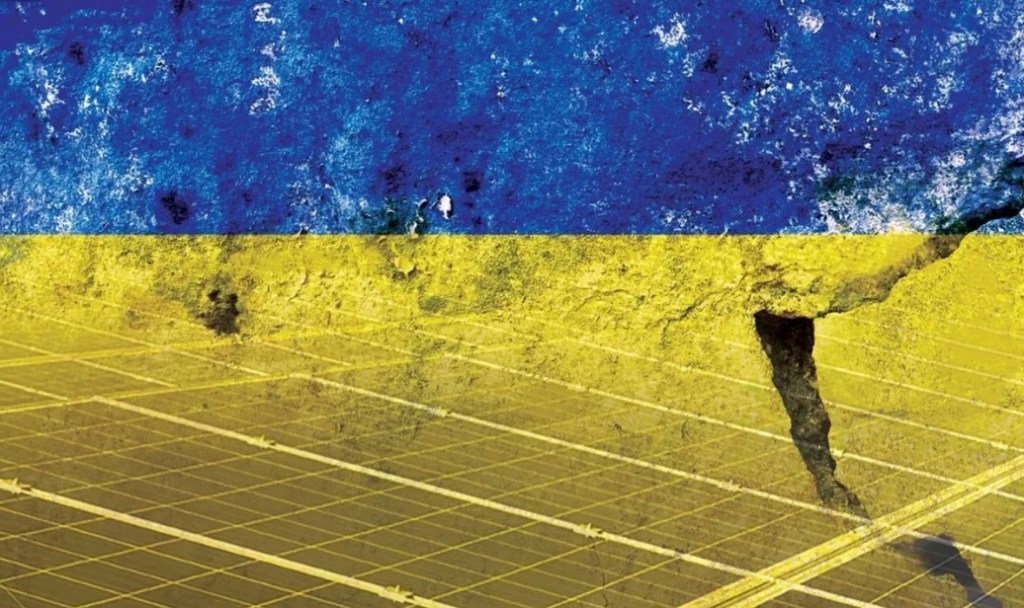
Global security can be greatly enhanced by massive adoption of solar power in several key ways. It can reduce exposure to hostile, energy-exporting nations. It can diminish the compulsion to engage in conflict over energy resources. It can improve the resiliency and security of standing militaries. Perhaps most significantly, it can slow the effects of climate change, which can disrupt nations although it may not cause wars directly.
Adoption of Solar Power Increases National Security and Energy Resilience
Russia’s invasion of Ukraine has sharply exposed the impractical thinking of many Western countries in making their economies dependent on a potentially hostile power for vital energy resources.
In 2021, the European Union imported more than 40% of its total gas consumption, 27% of oil imports and 46% of coal imports from Russia.1 In recent months, Russia has been reducing the flow of natural gas to Europe, including cutting the supply of natural gas to Germany via the main Nord Stream 1 pipeline by 75% in June 2022 and a further 50% in July 2022, after a 10-day shutdown for “maintenance work.” 2
European Commission President Ursula von der Leyen has said Russia cutting off all supplies to the EU is a “likely scenario.”
“Russia is blackmailing us. Russia is using energy as a weapon,” von der Leyen said.3
If it comes to pass, this dire scenario would negatively affect much of Europe’s population this winter, adversely impact industrial output, and significantly impact the price of natural gas on the global market.
This is not the first time energy exports have been used as a geopolitical weapon.
In 1973, Saudi Arabia led an embargo on oil exports from OPEC nations to Western countries that supported Israel in the Yom Kippur War, resulting in a severe economic shock in the embargoed countries, including the United States.
According to the U.S. Department of State, the embargo “contributed to an upward spiral in oil prices with global implications. The price of oil per barrel first doubled, then quadrupled, imposing skyrocketing costs on consumers and structural challenges to the stability of whole national economies.”4
In 1979, oil exports from Iran were disrupted due to oilfield strikes as part of the Iranian revolution, causing global oil output to drop by 7% between October 1978 and January 1979.5 While Iranian output recovered during 1979, it was again significantly impacted when the Iran-Iraq War erupted in September 1980 with the loss of production in both countries amounting to 6% of global output.6
These disruptions clearly highlight the risk of dependence on unstable regions for a critical resource.
While the lure of cheap, high-energy-density fossil fuels remains strong, the necessity of domestic control over energy resources has rarely been more apparent.
It is now clearer than ever that minimizing immediate financial cost cannot be the primary consideration when making energy investments.
Energy security and resiliency are also critical factors to consider.
With this in mind, how should countries, organizations and individuals go about protecting themselves from energy-supply shocks such as those being experienced today and in recent history?
To improve energy security and resiliency, I believe it is imperative to exercise as much control as possible over national sources of energy. This control mitigates the risk associated with being dependent on potentially hostile external parties for an essential resource.
This is best achieved through adoption of distributed energy resources that may include solar energy, including solar thermal energy, wind power, geothermal resources and other technologies.
A graph from the National Renewable Energy Laboratory shows the sparsely populated U.S. Southwest has enormous amounts of solar energy available, with large tracts of desert land usable for installation of large solar power plants.7
According to the U.S. Department of Energy, “PV panels on just 22,000 square miles of the nation’s total land area – about the size of Lake Michigan – could supply enough electricity to power the entire United States.” It has been estimated it could be as little as half that area.8
An additional important point, however, is that for solar power to provide energy security, domestic manufacturing of solar PV panels, inverters and related equipment, as well as solar thermal technologies, must also be adopted.
Currently, China has an over 80% share of all stages of the global PV-panel supply chain, with this share set to rise further in the future.9
Without domestic manufacturing, the supply of new solar equipment will, like natural gas and oil, be vulnerable to manipulation by potentially hostile external parties. Therefore, it is critically important that the U.S. and other nations build their domestic solar industries.
Adoption of Solar Power Reduces the National Compulsion to Engage in Conflict
Many military conflicts have been driven by a desire for control of energy resources. During World War II, Japan’s attack on Pearl Harbor was prompted by a U.S. embargo on oil exports to that country, which itself was prompted by Japan’s invasion of Indochina to prevent the United States supplying oil to China.
Similarly, Nazi Germany’s lack of domestic oil resources was a key driver of its invasion of the Caucasus. As Maj. Shawn Keller of the U.S. Air Force described it in a research paper, “Control of Caucasus oil would not only provide a permanent solution to the German oil crisis. It would be a deathblow to Soviet war production and allow Germany to continue the fight against its growing list of adversaries, which now included the United States.”10
The critical need to control oil resources, for both economic and military purposes, is also purported to be a reason for the United States’ engagement in several recent military conflicts, including the Gulf War in 1990 and Iraq War in 2003, as well as its significant ongoing military presence throughout the Middle East, with thousands of U.S. troops at bases across multiple countries.11
Solar energy could help countries move away from a fossil fuel-based economy and military towards an electrified, solar-driven energy architecture, reducing the pressure to engage in military action to secure access to the critical energy resources required for economic prosperity and security.
Adoption of Solar Power Improves Military Resiliency
The U.S. military is the largest institutional consumer of petroleum in the world, emitting more greenhouse gases than many countries.12
It is not possible to operate a modern air force, navy and army without huge and uninterrupted supplies of oil.
“Energy is the lifeblood of our warfighting capabilities,” General David Patreus said in 2011.13 Access to a continued supply of fossil fuels has thus been vital to the national security of the United States and other nations protected by modern fossil fuel-dependent militaries.
In order to mitigate the significant risk associated with dependence on fossil fuels, militaries should seek to increase reliance where possible on domestically controlled energy resources.
By adopting solar energy to power installations at domestic military facilities, overseas permanent bases and forward operating bases, militaries can make a step towards reduced dependence on fuel supplies, thereby derisking their operations and increasing the resilience and robustness with which they can serve their missions.
Increased Use of Solar Power May Reduce Conflict by Slowing Climate Change
The rapidly changing climate, driven by anthropogenic CO2 emissions, is expected to become an increasingly significant cause of societal stress in many regions of the world, with climate effects leading to secondary or indirect effects elsewhere, contributing to instability and/or conflict.
According to the U.S. Department of Defense Climate Risk Analysis from 2021, “While the effects of climate change are global, specific hazards, impacts and risks associated with climate change will differ by region. The majority of climate hazards are not new; however, climate change is altering the frequency, intensity and location of the hazards, contributing to vulnerability and compounding risks.”14
Some argue that the Syrian civil war was caused in part by climate change where an abnormally severe drought led to crop failure and farmers abandoning their land and fleeing to cities in huge numbers, contributing to social instability.15
By displacing fossil fuels and thus reducing the severity of climate change, use of low-emission technologies such as solar photovoltaic and solar thermal energy can help mitigate the effects of climate change, such as drought, flooding and migration.
Adoption of solar power on a grand scale could be a major contributor to global peace by putting citizens, communities, organizations and nations in greater control over their energy resources, reducing reliance on outsiders for energy, and diminishing the compulsion to conflict.
By helping to slow the pace of climate change, large-scale adoption of solar energy can also assist in mitigating the impact of a key driver of current and future conflict. As U.S. Secretary of Defense Lloyd Austin said, “No nation can find lasting security without addressing the climate crisis.”16
Originally published in SOLAR TODAY, Fall 2022 edition.
Sources
- https://tinyurl.com/3jr9bjmr
- https://tinyurl.com/yk8wswj7
- https://tinyurl.com/y3ju95am
- https://tinyurl.com/6ze2a828
- See page 16 of https://tinyurl.com/2p87tw9j
- See page 17 of https://tinyurl.com/2p87tw9j
- https://tinyurl.com/2n6vk2hs
- https://tinyurl.com/bdcssn78
- https://tinyurl.com/4mfnvf94
- See page 15 of https://tinyurl.com/4jtw6x7e
- https://tinyurl.com/55hvze5d
- See page 2 of https://tinyurl.com/55nnejhr
- https://tinyurl.com/4x9p6uk8
- https://tinyurl.com/ywtzh36t
- https://tinyurl.com/r75yk5t4
 Naoise Irwin
Leave a comment